
How to Choose Binoculars: Complete Guide for Beginners 2026
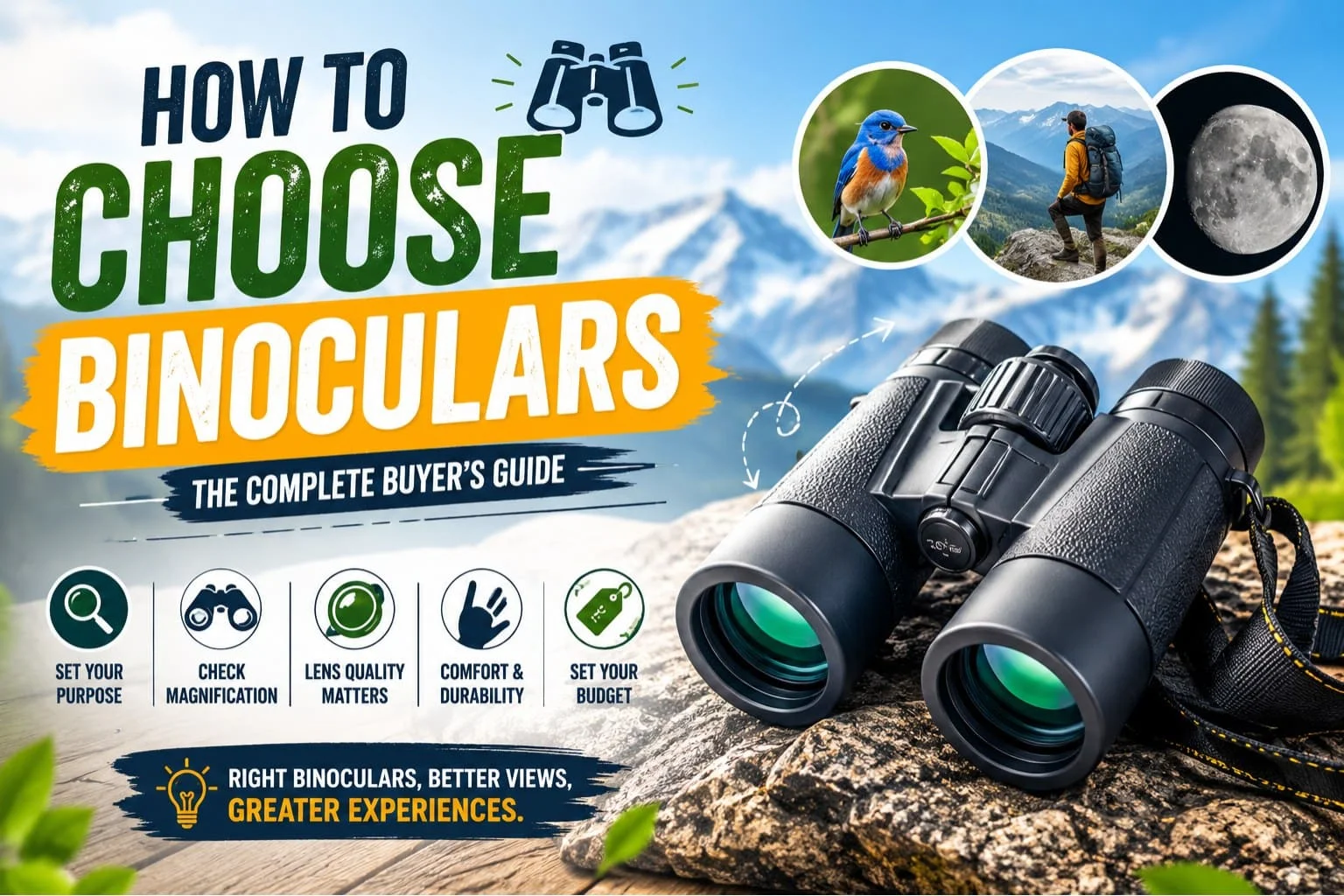
Choosing the right pair of binoculars can feel overwhelming with so many numbers, specs, and brands competing for your attention. Whether you’re heading into the Kruger, birding in the Cape, watching rugby at Loftus, or stargazing in the Karoo, this guide breaks down everything you need to know to pick the perfect binoculars for your needs and your budget in rands.
What Do the Numbers on Binoculars Mean?
Every pair of binoculars is labeled with two numbers, such as 8×42 or 10×50. Understanding these is the first step to choosing wisely.
- The first number (magnification): This tells you how many times closer an object appears. An 8x binocular makes objects look eight times closer than they do to the naked eye.
- The second number (objective lens diameter): Measured in millimeters, this is the size of the front lenses. Larger lenses gather more light, giving brighter images in low light.
For most South Africans, 8×42 offers the best balance of magnification, brightness, and stability, ideal for everything from game drives to back-garden birding.
How Do Binoculars Work?
Understanding the basics of how binoculars work helps you make a smarter buying decision and get the most out of your pair in the field.
At their core, binoculars are simply two small telescopes mounted side by side, one for each eye, which is what gives you a natural, three-dimensional view rather than the flat image you’d get from a single scope.
Here’s what happens when you look through them:
- Light enters the objective lenses. The large front lenses gather light from the distant subject, a soaring eagle or a grazing kudu, and bend it to form an image inside the binocular. The larger these lenses are, the more light they collect, which is why larger objectives perform better at dawn and dusk.
- Prisms flip the image the right way up. The image formed by the lenses is actually upside down and reversed. A set of glass prisms (roof or Porro) folds the light path and corrects the orientation so you see the world the right way round. This folding also lets manufacturers keep binoculars reasonably compact.
- The eyepieces magnify the image. The smaller lenses you look through enlarge the corrected image so your eyes perceive the subject as much closer than it really is.
- Focusing brings it all into sharpness. Turning the central focus wheel moves the lenses slightly to produce a crisp image at different distances. At the same time, the dioptre adjustment (usually on the right eyepiece) lets you fine-tune for any difference between your two eyes.
In short, binoculars gather light, correct and magnify the image, and deliver a bright, sharp, upright view to both eyes at once. The quality of the glass, lens coatings, and prisms is what separates a dull, fuzzy budget pair from a bright, razor-sharp premium one.
Magnification: Higher Isn’t Always Better
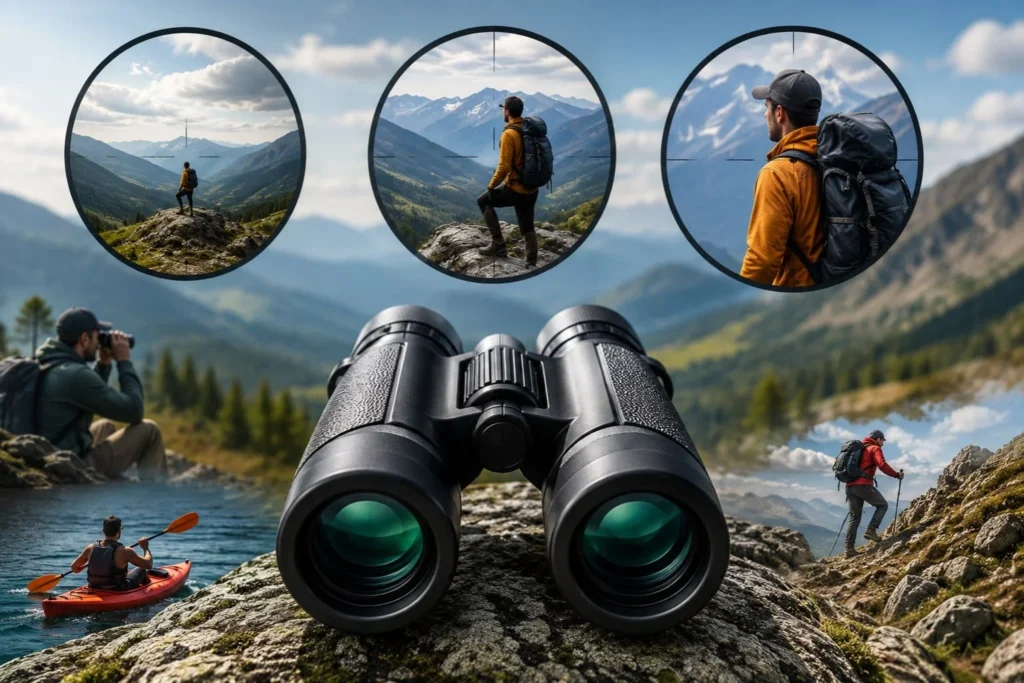
It’s tempting to grab the highest magnification available, but more power has trade-offs:
- Lower magnification (7x–8x): Wider field of view, steadier image, easier to track moving subjects. Ideal for birding and game viewing from a bumpy vehicle.
- Higher magnification (10x–12x): Brings distant objects closer but amplifies hand shake, narrows your field of view, and can produce dimmer images.
If you can’t hold binoculars perfectly still, anything above 10x may need a tripod or beanbag, handy for resting on a 4×4 window frame in the bush.
Objective Lens Size: Balancing Brightness and Weight
Larger objective lenses deliver brighter, clearer views, especially during the golden hours of an early morning or late afternoon game drive when animals are most active. But they also add weight and bulk.
- Compact (20–28mm): Lightweight, great for travel and daytime use.
- Mid-size (30–42 mm): The sweet spot for most activities, including safari.
- Full-size (50mm+): Best for astronomy under our clear Karoo skies and low-light conditions, but heavier.
Field of View: Why It Matters
Field of view (FOV) is how wide an area you can see, usually expressed in meters at 1,000 meters. A wider FOV makes it easier to locate and follow moving subjects, whether that’s a fast-flying sunbird or a leopard slipping through the bush. Lower magnification generally means a wider field of view.
Prism Type: Roof vs. Porro
- Roof prism: Slim, lightweight, and durable. More common in modern binoculars and easier to pack in a daypack.
- Porro prism: Bulkier, but often offers better depth perception and value for money.
Key Features to Check Before Buying
When comparing models, look beyond the basic specs:
- Lens coatings: “Fully multi-coated” lenses give the brightest, sharpest images.
- Waterproofing and fog-proofing: Essential for our summer thunderstorms and humid coastal conditions in KwaZulu-Natal.
- Eye relief: Important if you wear glasses; look for 15mm or more.
- Close focus distance: Matters for watching butterflies, chameleons, or insects up close.
- Weight and ergonomics: You’ll be holding these for hours on a game drive, so comfort counts.
What Binoculars Are Best for Bird Watching?
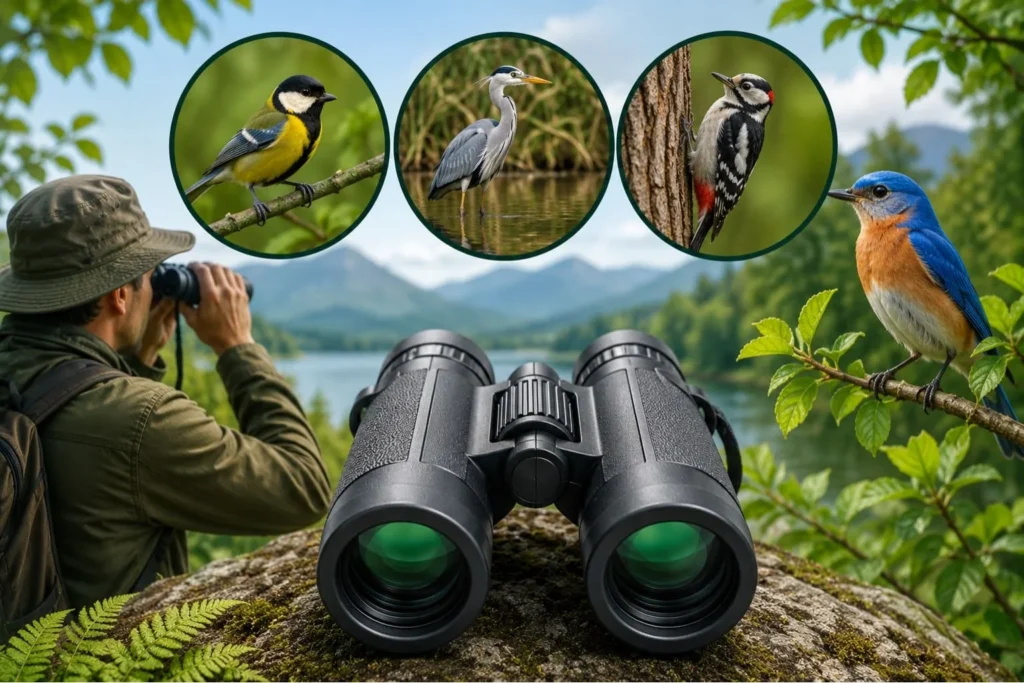
Birdwatching is one of the most demanding uses for the best compact binoculars; you need to find small, fast, often well-camouflaged birds quickly and see them in fine detail. South Africa is a birding paradise, home to over 850 species from the sugarbirds of the fynbos to the lilac-breasted roller of the bushveld, so the right pair makes a real difference.
For most birders, 8×42 is the gold standard, and here’s why:
- 8x magnification is easy to hold steady, so you won’t lose a flitting warbler to shaky hands, and it gives you a wide enough field of view to locate birds quickly in dense foliage.
- 42mm objective lenses pull in plenty of light for the low-light conditions common at dawn and dusk, when birds are most active.
- The combination keeps weight manageable for long mornings in the field with your binoculars around your neck.
If you mostly bird in open country, grasslands, wetlands, or coastal areas, where light is good, and birds are farther away, a 10×42 pair gives you extra reach, at the cost of a slightly narrower view and a touch more hand shake.
When choosing binoculars specifically for birding, prioritize these features:
- Close focus distance of around 2 meters or less, so you can enjoy butterflies, sunbirds, and warblers feeding nearby.
- Wide field of view to track birds in flight and relocate them in thick bush.
- Fully multi-coated lenses for the color accuracy needed to tell tricky LBJs (“little brown jobs”) apart.
- Waterproofing, essential for misty Cape mornings and KwaZulu-Natal humidity.
- Comfortable eye relief, especially if you wear glasses.
For South African birders on a budget, solid entry-level 8×42 pairs are widely available, while serious enthusiasts often invest in premium glass that reveals subtle plumage detail in challenging light.
Best Binoculars by Activity
Different activities call for different specs. Here’s a quick reference for South African conditions:
| Activity | Recommended Spec | Why |
| Safari & game viewing | 8×42 | Wide view, bright, steady in a vehicle |
| Birdwatching | 8×42 | Wide view, great for fynbos and bushveld |
| Hunting | 10×42 | Reach with a manageable weight |
| Astronomy (Karoo skies) | 10×50 or 15×70 | Maximum light gathering |
| Rugby & cricket | 8×25 | Compact and portable for the stadium |
| Hiking (Drakensberg) | 8×32 | Lightweight all-rounder |
| Whale watching (Hermanus) | 7×50 | Stable, bright, wide field |
How Much Should You Spend?
Prices vary by retailer and import costs, but here’s a realistic guide in Rands:
- Under R1,500: Good for casual, occasional use and first-time buyers.
- R1,500–R5,000: Solid mid-range optics for regular hobbyists and weekend safaris.
- R5,000–R12,000: Excellent clarity, durability, and low-light performance.
- R12,000+: Premium glass (think Swarovski, Zeiss, Leica) for serious enthusiasts and safari guides.
Buy the best you can comfortably afford. Quality optics are a long-term investment that can last decades.
Where to Buy Binoculars in South Africa
You’ll find binoculars at outdoor and optics retailers such as Outdoor Warehouse, Cape Union Mart, Safari & Outdoor, and specialist optics shops. Online options include Takealot and dedicated birding and optics suppliers. For premium brands, look for authorized dealers to ensure you get a genuine product with a valid warranty.
Common Mistakes to Avoid
- Choosing a magnification that’s too high to hold steady on a moving game vehicle.
- Ignoring lens coatings and waterproofing.
- Overlooking weight, then leaving the binoculars in the chalet.
- Buying on brand name alone without checking specs.
- Forgetting to budget for a decent harness or strap for long days in the field.
Frequently Asked Questions
What are the best binoculars for safari in South Africa?
8×42 is the go-to choice for safari, offering a bright image, a wide field of view, and enough stability to use from a moving game vehicle.
What is the best all-around magnification for binoculars?
8x is the most versatile choice, balancing image stability, brightness, and field of view for most uses, from birding to the bushveld.
Are expensive binoculars worth it?
Higher-end models offer noticeably better clarity, durability, and low-light performance, which matters during early-morning and dusk game drives. If you use binoculars often, the upgrade is usually worth it.
Can I use binoculars with glasses?
Yes. Look for binoculars with at least 15mm of eye relief and twist-down eyecups.
What’s better for beginners, 8×42 or 10×42?
8×42 is generally easier for beginners because it’s steadier and has a wider field of view.
Click to view a compact range of the best binoculars.
Other Products:
